Petroglyph Research with Dr. Chester Liwosz - Rock Art 10

On today's episode Dr. Gold talks with Dr. Chester Liwosz. Dr. Liwosz tells us how he got into archaeology and how he came to study petroglyphs. We also talk about his involvement with the Mesa Prieta Petroglyph project and the amazing collection of rock art at that site.
Links
Contact
Chris Webster
Dr. Alan Garfinkel
Affiliates
Find this show on the educational podcast app, Lyceum.fm!
Work From Home Assessment - ArchaeoTech 135
We’ve been working from home since March of this year and for some archaeologists it’s been difficult. Paul and Chris talk about how it’s gone for them, what’s helped, and what’s been a challenge. Let us know what’s helped you!
Links
Contact
Chris Webster
Twitter: @archeowebby
Paul Zimmerman
Twitter: @lugal
Email: paul@lugal.com
Affiliates
Find this show on the educational podcast app, Lyceum.fm!
Sovereign Stories - HeVo 42

On this months’s podcast we have LT Kayla F. DeVault (Shawnee and Anishinaabe), Engineer and Project Manager at Indian health facilities. Kayla’s wide ranging experience and education has centered on Anthropology, STEM, and Indigeneity. She is the host of the You-tube channel, Sovereign Stories, which breaks down Indigenous themed topics into easy to understand and fun short videos. We talk about advocacy more generally as well as a wide range of other topics including cultural heritage and development, consent, othering, bias, tokenization and allyship.
Links
https://www.penguinrandomhouse.com/books/567167/as-long-as-grass-grows-by-dina-gilio-whitaker/
Red Alert! Saving the Planet with Indigenous Knowledge by Daniel R. Wildcat
"Aboriginalism & the Problems of Indigenous Archaeology" by Robert McGhee, American Antiquity
Our Knowledge is Not Primitive: Decolonizing Botanical Anishinaabe Teaching by Wendy Makoons Geniusz
Contact
Jessica
Kayla
@SovereignStorys
Lyle
Affiliates
Find this show on the educational podcast app, Lyceum.fm!
Illustrating Archaeology - Dirt 103

This week, Anna and Amber take on archaeological illustration. That's right-it's an audio episode about an entirely visual topic! This'll go well. We cover the merits of hand drawing vs. photography, reveal some stories from our own...mixed experiences, and investigate the very cool technique of photogrammetry.
Links
Why Archaeological drawing is still so important (New Archaeology)
A Simple Method for Reliable Creation of 3D Artifact Models in the Field (Leakey Foundation)
‘Visual competence’ in archaeology: a problem hiding in plain sight (Antiquity)
Science and Art in Archaeological Illustration (Columbia College)
Approaches to Archaeological Illustration, A Handbook by Mélanie Steiner (via Digital Epigraphy)
Contact
Affiliates
Find this show on the educational podcast app, Lyceum.fm!
Neanderthals Making Yarn?! - TAS 98
This is a crossover episode with Rachel Roden and Historical Yarns!
Recently, evidence of twisted cord was discovered on a Neanderthal archaeological site. While the exact use of this cord is unknown, we discuss our theories for how Neanderthals could have applied this technology to everyday life. Most importantly, this discovery contributes to breaking down the myth that Neanderthals were technologically inferior to their human contemporaries.
Links
Contact
Affiliates
Find this show on the educational podcast app, Lyceum.fm!
CRAF and ArchaeoAstronomy with Christine Grimaldi Clarkson - Rock Art 9
On today's show Dr. Garfinkel interviews the Executive Director of the California Rock Art Foundation, Christine Grimaldi Clarkson. Christine was instrumental in the creation and development of the California Rock Art Foundation and was elected by the Board to be the Executive Director of CRAF in March 2018. Christine has been researching and conducting archaeological work in Central California for over 20 years, and also pursues interests in Southwest and Mesoamerican archaeology. Her research has led to the discovery and documentation of an ancient astronomical observation area created by Native Americans in Central California. Articles on this subject have been published in SCA Proceedings and Rock Art Papers.
Links
Contact
Chris Webster
Dr. Alan Garfinkel
Affiliates
Find this show on the educational podcast app, Lyceum.fm!
Grants, and Fellowships, and Scholarships, Oh My! - Dig It 10

In this episode, we discuss the inter-workings of different parts on finding grants especially as we start to enter grant-writing and application season. We touch on why grants are important, when to apply, how to find them, and what goes in them.
Links
Contact
Show
Twitter: @idigitpodcast
Email: idigitpodcast@gmail.com
Alyssa
Instagram: aal.archaeology
Twitter: Lyssakemi
Michaela
Instagram: mm_digitalized
Twitter: m_mauriello
Affiliates
Find this show on the educational podcast app, Lyceum.fm!
Stories from the Field and Lessons Learned - CRMarch 195
Description: We all have our stories where we "barely got out", or, "I can't believe that happened!" On today's episode Heather opens up and tells us about an experience just last year that her and her co-worker barely got out alive from. There were a lot of lessons learned from that incident and we hope you can learn from this as well.
Follow Our Panelists On Twitter
Bill @succinctbill; Doug @openaccessarch; Stephen @processarch; Bill A. @archaeothoughts; Chris W @Archeowebby, @DIGTECHLLC, and @ArchPodNet
Blogs:
Bill White: Succinct Research
Doug Rocks-MacQueen: Doug’s Archaeology
Stephen Wagner: Process - Opinions on Doing Archaeology
Chris Webster: Random Acts of Science
Affiliates
Find this show on the educational podcast app, Lyceum.fm!
Chalk it Up to Science - Dirt 102
This week, on a short but fun episode, Anna and Amber investigate some of the massive figures cut into the chalk landscape of the Southern UK. Who made them? How old are they? Why are there so many horses?
Links
England’s 7 most intriguing chalk figures and the stories behind them (Wanderlust)
An Introduction to Prehistoric England (Before 43 BC) (English Heritage)
Footprints, Size 10, From Britain’s Bronze Age (The New Yorker)
The Beaker phenomenon and the genomic transformation of northwest Europe (Nature)
Against All Odds, England’s Massive Chalk Horse Has Survived 3,000 Years (Smithsonian)
England’s Enormous Chalk Figures (Atlas Obscura via Google Earth)
Britain's Spectacular (and Sometimes Mysterious) Hill Figures (Gizmodo UK)
Contact
Affiliates
Find this show on the educational podcast app, Lyceum.fm!
If a Yoda, Archaeology had: A Philosophical Discussion with our Mentor Dr. Robert L. Kelly - Ruins 27

On Episode 27 of A Life in Ruins Podcast, we interview Dr. Robert L. Kelly. Dr. Kelly was all the cohosts thesis advisor at the University of Wyoming. Dr. Robert L. Kelly wrote the book, The Lifeways of Hunter-Gatherers: The Foraging Spectrum, on hunter-gatherer archaeology and the mathematical proofs behind it.
He was involved in early research at Gatecliff Rockshelter and then he continued on to influence archaeological theory for the rest of his career. He writes a regular textbook with Dr. David Hurst Thomas named “Archaeology” (latest edition).
He has also written a book on the future of archaeology called The Fifth Beginning.
We have a super interesting philosophical conversation about archaeology and its meaning. Bob recounts his early life and how he found his way out in the desert with David Hurst Thomas during his first days as an archaeologist.
We then discuss his transition from Cornell to the University of New Mexico and the University of Michigan, and have a lengthy discussion about his mentor, Lewis Binford and his eccentric life.
The majority of the podcast however, is an in-depth conversation about anthropology, how the field has changed over the years, and what it means to be human.
Robert L Kelly Email: rlkelly@uwyo.edu
Contact
Instagram: @alifeinruinspodcast
Facebook: @alifeinruinspodcast
Twitter: @alifeinruinspod
Website: www.alifeinruins.com
Affiliates
Find this show on the educational podcast app, Lyceum.fm!
Liminal Places with Rebecca Lambert - TAS 97
Rebecca Lambert studies those places in our world that we don't either think about or even like to think about. Shadows, hidden areas, underpasses. These places are sometimes scary, sometimes strange, and sometimes make you feel different on the other side. What can we learn about places on the edge, or, liminal places? We explore these spaces on today's episode.
Links
Rebecca's Twitter: @LadyLiminal1
Contact
Chris Webster
Affiliates
Find this show on the educational podcast app, Lyceum.fm!
Bighorn Sheep of California with Carlos Gallinger - Rock Art 8
Carlos Gallinger is a world class wildlife specialist. Mr. Gallinger has spent much of his life studying the habits, habitat, and associated prehistoric activities of the big horn sheep in central eastern California. Carlos has studied native-American interactions with big horn sheep and their hunting of these animals through what they left behind and the rock art, pictographs, and geoglyphs left on the landscape.
Links
Contact
Chris Webster
Dr. Alan Garfinkel
Affiliates
Find this show on the educational podcast app, Lyceum.fm!
Finding Hidden Rooms at Teotihuacan with Science - Archaeotech 134
Teotihuacan was a massive, important, city near modern day Mexico City. There are several massive pyramids on the site and two of them have caves UNDER the pyramid. The pyramid of the moon was the focus of the paper linked below and Denisse Argote and Andres Tejero use two techniques to try to identify the presence or absense of a cave beneath it. Those techniques are Electrical Resistivity Tomography (ERT) and Ambient Noise Tomography (ANT).
Links
Contact
Chris Webster
Twitter: @archeowebby
Paul Zimmerman
Twitter: @lugal
Email: paul@lugal.com
Affiliates
Find this show on the educational podcast app, Lyceum.fm!
Culinary Zooarchaeology - Animals 25
In this episode, Alex and Simona will be tackling culinary zooarchaeology. Listen on to find out more about how to identify food preparation in the archaeological record, ancient BBQs and interpreting archaeological rubbish.
Links
Besherer Metheny, K. and Beaudry, M.C. (2015) Archaeology of Food: An Encyclopedia. Rowman & Littlefield.
Binford, L. (1981) Bones: Ancient Men and Modern Myths.
Pavao-Zuckerman, B., Anderson, D.T. & Reeves, M. (2018) Dining with the Madisons: Elite Consumption at Montpelier. Hist Arch 52, 372–396.
O'Connor, T. (2000) The Archaeology of Animal Bones. Gloustershire: Sutton Publishing Ltd.
Rackham, J. (1994) Interpreting the past: Animal Bones
Hastorf C.A. (2008) Food and feasting, social and political aspects. In: Pearsall D.M. (ed) Encyclopedia of Archaeology. London: Elsevier Inc.
Nelson S.M. (2003) Feasting the Ancestors in Early China. In: Bray T.L. (eds) The Archaeology and Politics of Food and Feasting in Early States and Empires. Springer, Boston, MA
Maisels, C. (2010) The Archaeology of Politics and Power: Where, When and Why the First States Formed. Oxford, Oxbow books
Russell, N. (2012) Social Zooarchaeology. Cambridge University Press.
Elliot, P. (2016) Food and Farming in Prehistoric Britain. Fonthill Media
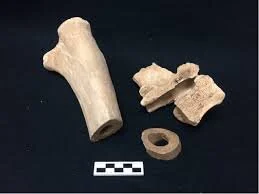
Butchered Animal Bone
Contact
Alex FitzpatrickTwitter: @archaeologyfitz
Simona FalangaTwitter: @CrazyBoneLady
Alex’s Blog: Animal Archaeology
Music "Coconut - (dyalla remix)" https://www.youtube.com/watch?v=_2UiKoouqaY
Affiliates
Find this show on the educational podcast app, Lyceum.fm!
Mythteries and Mythnomers - Dirt 101
Since back-to-school season is rolling around again, let's return to our annual tradition of busting myths and righting wrongs! This time, we cover pyramid construction (and curses), the Genghis Khan family reunion, the end of James Cook, Stonehenge, the Dark Ages, and more. This episode is not to be myth-ed.
Links
This 4,500-Year-Old Ramp Contraption May Have Been Used to Build Egypt's Great Pyramid (LiveScience)
'Bent' pyramid: Egypt opens ancient oddity for tourism (The Guardian)
Ancient Egyptian tomb warnings, curses and ghosts (National Museums Scotland)
Whence Came Stonehenge’s Stones? Now We Know (The New York Times)
Did Genghis Khan really kill 1,748,000 people in one hour? (How Stuff Works)
1 in 200 Men Are Direct Descendants of Genghis Khan (Discover)
Genghis Khan's Genetic Legacy Has Competition (Scientific American)
The genetic imprint of Niall of the Nine Hostages (Irish Times)
A Y-Chromosome Signature of Hegemony in Gaelic Ireland (American Journal of Human Genetics)
Mythbusting Cook: Fact fiction and total fallacy (Australian National Maritime Museum)
How the foolish rumour that Hawaiians ate Cook began (National Indigenous Television)
Contact
Affiliates
Find this show on the educational podcast app, Lyceum.fm!
YCTA July 26, 2020 - TAS 96
Welcome to another re-broadcast of the live You Call This Archaeology show with Richie Cruz and Chris Webster. On today's episode we talk a lot about camping, RVs, and summer fieldwork.
Links
Contact
Chris Webster
Affiliates
Find this show on the educational podcast app, Lyceum.fm!
Filming Rock Art with Eran Barnea - Rock Art 7
Eran Barnea is a Hollywood cinematographer who has completed research studies worldwide on rock art depicting horned artiodactyls. His studies relate to the symbolism and religious metaphors world-wide of these remarkable animals.
Links
Contact
Chris Webster
Dr. Alan Garfinkel
Affiliates
Find this show on the educational podcast app, Lyceum.fm!
Life As A Post-Grad - Dig It 9
In this episode we will be having a chat about our experiences within and mainly after undergrad, jobs, making connections, and asking for help.
Contact
Show
Twitter: @idigitpodcast
Email: idigitpodcast@gmail.com
Alyssa
Instagram: aal.archaeology
Twitter: Lyssakemi
Michaela
Instagram: mm_digitalized
Twitter: m_mauriello
Affiliates
Find this show on the educational podcast app, Lyceum.fm!
A Panel Discussion on Diversity in Archaeology - CRM Arch 194
Welcome to a special episode of the CRM Archaeology Podcast. On this episode, host of the show Dr. Bill White brings on a panel of career archaeologists to talk about diversity in archaeology. Not just diversity and the current situation, though, but what we, as a profession, can do about it.
Links
Follow Our Panelists On Twitter
Bill @succinctbill; Doug @openaccessarch; Stephen @processarch; Bill A. @archaeothoughts; Chris W @Archeowebby, @DIGTECHLLC, and @ArchPodNet
Blogs:
Bill White: Succinct Research
Doug Rocks-MacQueen: Doug’s Archaeology
Stephen Wagner: Process - Opinions on Doing Archaeology
Chris Webster: Random Acts of Science
Affiliates
Find this show on the educational podcast app, Lyceum.fm!
It's Time to Talk About the Future - Dirt 100
This week, for our ONE HUNDREDTH EPISODE, Anna and Amber bend their brains around the archaeology of the future and the future of archaeology. What will excavation look like in 100, 1,000, or 5,000 years? What about human evolution? Human culture? Language? We come up with more questions than answers, and have a great time doing it. THANK YOU for getting us to Episode 100!
Links
The broiler chicken as a signal of a human reconfigured biosphere (Royal Society Open Science)
Dougal Dixon - After Man (A Zoology of the Future) 1981 (Monster Brains blog)
What will English language look like in the future? (Oxford Academic on YouTube)
What will the English language be like in 100 years? (The Conversation)
Pleistocenese: A Language of 40,000 Years Ago (Justin B. Rye)
Beyond Biohazard: Why Danger Symbols Can’t Last Forever (99% Invisible)