
This is a podcast from the Archaeology Podcast Network about the relationship between animals and humans on archaeology sites - it’s called Zooarchaeology and we have a couple of experts, Alex Fitzpatrick and Simona Falanga, to guide you through it.
On Frog-Toads and Other Amphibian Dilemmas - Ep 53

In this episode of ArchaeoAnimals, take a journey into the world of amphibians with us. Witness the latest of Alex’s hot archaeology takes, discover the unbelievable cuteness of the axolotl and why amphibian remains are so crucial to the reconstruction of past environments.
Transcripts
Links and Sources
Buckley, M., & Cheylan, M. (2020). Collagen fingerprinting for the species identification of archaeological amphibian remains. Boreas, 49(4), 709-717.
Dittrich, C., & Götting-Martin, E. (2021). ‘Green Frog in the Water’. A Herpetological Approach to the Magico-Medical Use of Frogs and Frog-Amulets in Mesopotamia. In Bridging the Gap: Disciplines, Times, and Spaces in Dialogue. Archaeopress Publishing Ltd.
O'Connor, T. (2008) The Archaeology of Animal Bones. Texas A&M University Press.
Porcasi, J. F. (2010). Archaeological evidence for dietary use of bigfoot leopard frog (Lithobates megapoda) in postclassic and colonial central Mexico. Culture & Agriculture. 32 (1): 42–48.
Yan, F. et al. (2018). The Chinese giant salamander exemplifies the hidden extinction of cryptic species. Current Biology, 28(10), R590-R592.
Contact
Alex FitzpatrickTwitter: @archaeologyfitz
Simona FalangaTwitter: @CrazyBoneLady
Alex’s Blog: Animal Archaeology
Music "Coconut - (dyalla remix)" https://www.youtube.com/watch?v=_2UiKoouqaY
Affiliates
Xenomorph Archaeology - Ep 52
In this belated spooky episode, we untangle the web that is xenomorph anatomy, the creatures from the popular Alien franchise. Listen in for tales of stress inducing videogame sessions, what a dog xenomorph looks like, and in-depth analysis of the role of the facehugger in the xenomorph life cycle.
Transcripts
Links
Contact
Alex FitzpatrickTwitter: @archaeologyfitz
Simona FalangaTwitter: @CrazyBoneLady
Alex’s Blog: Animal Archaeology
Music "Coconut - (dyalla remix)" https://www.youtube.com/watch?v=_2UiKoouqaY
Affiliates
Fine, Let's Rank Our Favourite Animal Bones - Ep 51
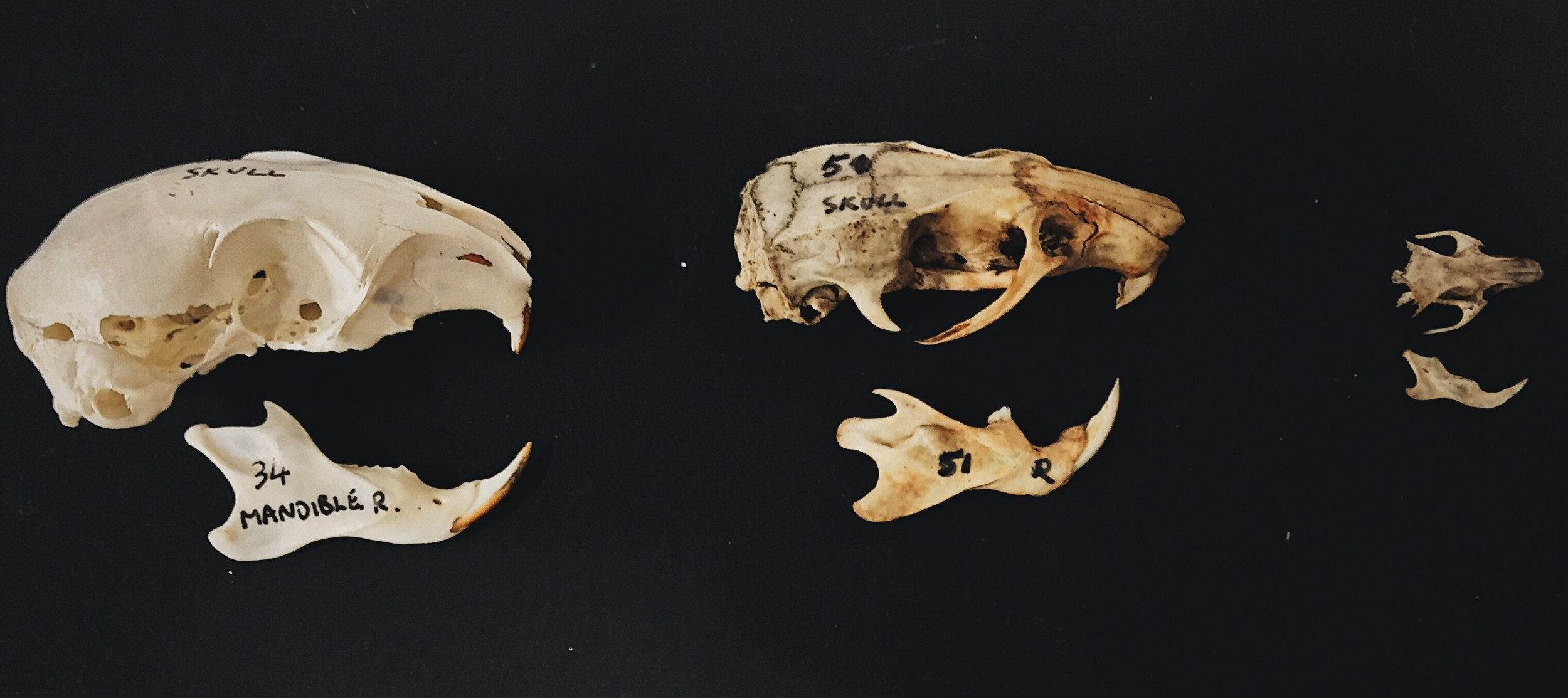
In this episode of ArchaeoAnimals, Alex and Simona put their party hats on to discuss their favourite animal bones as a (slightly belated) celebration of the first 50 episodes of the podcast!
Transcripts
Contact
Alex FitzpatrickTwitter: @archaeologyfitz
Simona FalangaTwitter: @CrazyBoneLady
Alex’s Blog: Animal Archaeology
Music "Coconut - (dyalla remix)" https://www.youtube.com/watch?v=_2UiKoouqaY
Affiliates
Where in the World? Part Six: The Zooarchaeology of Antarctica - Ep 50
Welcome to the final episode of our miniseries focusing on the zooarchaeology of various world regions. This episode is centred around Antarctica, focusing on the natural history and anatomy of the most prominent wild and domesticated species found throughout the continent. Tune in to learn about exploration expeditions gone wrong and interestingly named Guernsey cattle.
Transcripts
Links
Headland, R. (2012). History of exotic terrestrial mammals in Antarctic regions. Polar Record, 48(2), 123-144.
Kelly, N. et al. (2012). Strategies to obtain a new circumpolar abundance estimate for Antarctic Blue Whales: survey design and sampling protocols. IWC SC/64/SH10.
Senatore, M. X. (2020). Things in Antarctica. An archaeological perspective. The Polar Journal, 10(2), 397-419.
Skinner, L. A. (2014). Archaeological excavation and artefact conservation at the Heroic-Era expedition bases, Ross Island, Antarctica. Journal of Glacial Archaeology ISSN (online), 2050, 3407.
https://polarjournal.ch/en/2021/06/24/antarctic-explorers-let-sled-dogs-starve/
https://www.courthousenews.com/scientists-sound-alarm-on-invasive-species-in-antarctica/
smithsonianmag.com/history/sacrifice-amid-the-ice-facing-facts-on-the-scott-expedition-96367423/
Contact
Alex FitzpatrickTwitter: @archaeologyfitz
Simona FalangaTwitter: @CrazyBoneLady
Alex’s Blog: Animal Archaeology
Music "Coconut - (dyalla remix)" https://www.youtube.com/watch?v=_2UiKoouqaY
Affiliates
Where in the World? Part Five: The Zooarchaeology of Oceania - Ep 49
Welcome to episode three of a miniseries focusing on the zooarchaeology of various world regions. Join us on a journey to Oceania as we learn about the natural history and anatomy of the most prominent wild and domesticated species found in the area. Tune in to learn more about creatures such as the cassowary, thylacine and platypus.
Transcripts
Sources
Álvarez-Varas, R., Barrios-Garrido, H., Skamiotis-Gómez, I., & Petitpas, R. (2020). Cultural role of sea turtles on Rapa Nui (Easter Island): Spatial and temporal contrast in the Pacific island region. Island Studies Journal, 15, 253-270.
Bessarab, D., & Forrest, S. (2017). Anggaba jina nimoonggoon: Whose knowledge is that? Aboriginal perspectives of community development. Mia Mia Aboriginal Community Development: Fostering cultural security. Cambridge: University Press, Cambridge, 1-18.
Bino, G. et al. (2019). The platypus: evolutionary history, biology, and an uncertain future. Journal of mammalogy, 100(2), 308-327.
DiNapoli, R. J., Lipo, C. P., & Hunt, T. L. (2021). Triumph of the Commons: Sustainable Community Practices on Rapa Nui (Easter Island). Sustainability, 13(21), 12118.
Douglass, K. et al. (2021). Late Pleistocene/Early Holocene sites in the montane forests of New Guinea yield early record of cassowary hunting and egg harvesting. Proceedings of the National Academy of Sciences, 118(40), e2100117118.
Field, J. et al. (2000). ‘Coming back’ Aborigines and archaeologists at Cuddie Springs. Public Archaeology, 1(1), 35-48.
Field, J., & Dodson, J. (1999). Late Pleistocene megafauna and archaeology from Cuddie Springs, south-eastern Australia. In Proceedings of the Prehistoric Society (Vol. 65, pp. 275-301). Cambridge University Press.
Hartnup, K. et al. (2011). Ancient DNA recovers the origins of Māori feather cloaks. Molecular Biology and Evolution, 28(10), 2741-2750.
Hofman, C. A., Rick, T. C., Fleischer, R. C., & Maldonado, J. E. (2015). Conservation archaeogenomics: ancient DNA and biodiversity in the Anthropocene. Trends in ecology & evolution, 30(9), 540-549.
Jackson, S. (2010). Koala: Origins of an Icon. Allen and Unwin.
Lawal, R. A., & Hanotte, O. (2021). Domestic chicken diversity: Origin, distribution, and adaptation. Animal Genetics, 52(4), 385-394.
Paddle, R. (2002) The last Tasmanian Tiger: the history and extinction of the Thylacine. Cambridge University Press.
Shipman, P. (2021). What the dingo says about dog domestication. The Anatomical Record, 304(1), 19-30.
Skippington, J., Manne, T., & Veth, P. (2018). Macropods and measurables: A critical review of contemporary isotopic approaches to palaeo-environmental reconstructions in Australian zooarchaeology. Journal of Archaeological Science: Reports, 17, 144-154.
Tsang, R. et al. (2021). Rock Art and (Re) Production of Narratives: A Cassowary Bone Dagger Stencil Perspective from Auwim, East Sepik, Papua New Guinea. Cambridge Archaeological Journal, 1-19.
Contact
Alex FitzpatrickTwitter: @archaeologyfitz
Simona FalangaTwitter: @CrazyBoneLady
Alex’s Blog: Animal Archaeology
Music "Coconut - (dyalla remix)" https://www.youtube.com/watch?v=_2UiKoouqaY
Affiliates
Where in the World? Part Four: The Zooarchaeology of Asia - Ep 48
Welcome to episode three of a miniseries focusing on the zooarchaeology of various world regions. This episode is centred around Asian zooarchaeology, focusing on the natural history and anatomy of the most prominent wild and domesticated species found throughout the continent. Tune in to learn how pandas were mistaken for tapirs, grunting oxen and oracle bones.
Transcripts
Links
Ameri, M. (2018). Letting the Pictures Speak: An Image-Based Approach to the Mythological and Narrative Imagery of the Harappan World. Seals and Sealing in the Ancient World: Case Studies from the Near East, Egypt, the Aegean, and South Asia, 144.
Bose, S. (2020). Mega Mammals in Ancient India: Rhinos, Tigers, and Elephants. Oxford University Press.
d’Alpoim Guedes, J., & Aldenderfer, M. (2020). The archaeology of the Early Tibetan Plateau: New research on the initial peopling through the Early Bronze Age. Journal of Archaeological Research, 28(3), 339-392.
Harper, D. (2013). The cultural history of the giant panda (Ailuropoda melanoleuca) in early China. Early China, 35(36), 2012-13.
Kumar, S., Ali, M., & Khoso, P. A. (2020). Emergence and Decline of the Indus Valley Civilization in Pakistan. Global Sociological Review, 2, 9-22.
Liu, K. et al. (2021). Radiocarbon dating of oracle bones of late Shang period in ancient China. Radiocarbon, 63(1), 155-175.
Liu, Y. C. et al. (2018). Genome-wide evolutionary analysis of natural history and adaptation in the world’s tigers. Current Biology, 28(23), 3840-3849.
Mohamad, K. et al. (2009). On the origin of Indonesian cattle. PLoS One, 4(5), e5490.
Uzzaman, M. R. et al. (2014). Semi-domesticated and Irreplaceable genetic resource gayal (Bos frontalis) needs effective genetic conservation in Bangladesh: a review. Asian-Australasian Journal of Animal Sciences, 27(9), 1368.
Yang, D.Y. et al. (2008). Wild or domesticated: DNA analysis of ancient water buffalo remains from north China. Journal of Archaeological Science, 35(10), pp.2778-2785.
Contact
Alex FitzpatrickTwitter: @archaeologyfitz
Simona FalangaTwitter: @CrazyBoneLady
Alex’s Blog: Animal Archaeology
Music "Coconut - (dyalla remix)" https://www.youtube.com/watch?v=_2UiKoouqaY
Affiliates
Where in the World? Part Three: The Zooarchaeology of the Americas - Ep 47
Welcome to episode three of a miniseries focusing on the zooarchaeology of various world regions. This episode is centered around American zooarchaeology, focusing on the natural history and anatomy of the most prominent wild and domesticated species found throughout North and South America. Tune in for beaver-pretenders, bison-cattle hybrids and even more moose/elk arguments!
Connect with James on Twitter: @paleoimaging
// Message for Megaphone (delete this, link the episode and insert the number in the text below):
For rough transcripts of this episode go to www.archpodnet.com/animals/#
Transcripts
Links
Anning, C. (2011) Inca success in Peruvian Andes 'thanks to llama dung'. BBC News.
Crader, D. C. (1997). Prehistoric use of beaver in coastal Maine (USA). Anthropozoologica, 25(26), 225-236.
- Halbert, N. et al. (2007). "Where the buffalo roam: The role of history and genetics in the conservation of bison on U.S. federal lands". Park Science. 24 (2): 22–29.
Hirst, K.K. (2018) Llamas and Alpacas: The Domestication History of Camelids in South America. ThoughtCo.
Hubbard, T. (2014). Buffalo Genocide in Nineteenth-Century North America. Colonial genocide in indigenous North America, 292-305.
Petrigh, R. S., & Fugassa, M. H. (2013). Molecular identification of a Fuegian dog belonging to the Fagnano Regional Museum ethnographic collection, Tierra del Fuego. Quaternary International, 317, 14-18.
Miller, G. R. (2003). Food for the dead, tools for the afterlife: Zooarchaeology at Machu Picchu. In Burger, R. L., and Salazar, L. C. (eds.), The 1912 Yale Peruvian Scientific Expedition Collections from Machu Picchu: Human and Animal Remains.
Saunders, N. J. (1994). Predators of Culture: Jaguar Symbolism and Mesoamerican Elites. World Archaeology, 26(1), 104–117.
Speller, C. F. et al. (2010). "Ancient mitochondrial DNA analysis reveals complexity of indigenous North American Canham domestication". Proceedings of the National Academy of Sciences. 107 (7): 2807–2812.
Turner, B. L., and Armelagos, G. J. (2012). "Diet, residential origin, and pathology at Machu Picchu, Peru". American Journal of Physical Anthropology. 149 (1): 71–83.
https://historicjamestowne.org/collections/artifacts/faunal-material/
https://blog.nature.org/science/2017/11/20/tracing-the-wild-origins-of-the-domestic-turkey/
Contact
Alex FitzpatrickTwitter: @archaeologyfitz
Simona FalangaTwitter: @CrazyBoneLady
Alex’s Blog: Animal Archaeology
Music "Coconut - (dyalla remix)" https://www.youtube.com/watch?v=_2UiKoouqaY
Affiliates
Where in the World? Part Two: The Zooarchaeology of Africa - Ep 46
Welcome to episode two of a miniseries focusing on the zooarchaeology of various world regions. This episode is centred around African zooarchaeology, focusing on the natural history and anatomy of the most prominent wild and domesticated species. Find out more about African Giant Rats, how loud Guinea fowls can be and what a zebrinny is.
Connect with James on Twitter: @paleoimaging
// Message for Megaphone (delete this, link the episode and insert the number in the text below):
For rough transcripts of this episode go to www.archpodnet.com/animals/#
Transcripts
Links
Beja-Pereira, A., et al. (2004). African origins of the domestic donkey. Science, 304, 1781.
Boeyens, J. C., & Van der Ryst, M. M. (2014). The cultural and symbolic significance of the African rhinoceros: a review of the traditional beliefs, perceptions and practices of agropastoralist societies in southern Africa. Southern African Humanities, 26(1), 21-55.
Marshall, F. (1989). Rethinking the role of Bos indicus in sub-Saharan Africa. Current Anthropology, 30(2), 235-240.
Parkinson, J. A. (2018). Revisiting the hunting-versus-scavenging debate at FLK Zinj: a GIS spatial analysis of bone surface modifications produced by hominins and carnivores in the FLK 22 assemblage, Olduvai Gorge, Tanzania. Palaeogeography, Palaeoclimatology, Palaeoecology, 511, 29-51.
Pikirayi, I. (2018). The demise of Great Zimbabwe, AD 1420–1550: an environmental re-appraisal. In A Green and R Leech (eds) Cities in the World, 1500-2000.Routledge, 31-47..
Potts, R. (1984). Home Bases and Early Hominids: Reevaluation of the fossil record at Olduvai Gorge suggests that the concentrations of bones and stone tools do not represent fully formed campsites but an antecedent to them. American Scientist, 72(4), 338-347.
Rossel, S. et al. (2008). Domestication of the donkey: Timing, processes, and indicators. Proceedings of the National Academy of Sciences, 105(10), 3715-3720.
Shen, Q. et al. (2021). Genomic analyses unveil helmeted guinea fowl (Numida meleagris) domestication in West Africa. Genome biology and evolution, 13(6).
Stiner, M. C. (2004). Comparative ecology and taphonomy of spotted hyenas, humans, and wolves in Pleistocene Italy. Revue de Paléobiologie, 23(2), 771-785.
Wylie, D. (2009). Elephant. Reaktion Books
Contact
Alex FitzpatrickTwitter: @archaeologyfitz
Simona FalangaTwitter: @CrazyBoneLady
Alex’s Blog: Animal Archaeology
Music "Coconut - (dyalla remix)" https://www.youtube.com/watch?v=_2UiKoouqaY
Affiliates
Where in the World? Part One: The Zooarchaeology of Europe - Ep 45
Welcome to episode one of a miniseries focusing on the zooarchaeology of various world regions. This episode is centred around European zooarchaeology, focusing on the natural history and anatomy of the most prominent wild and domesticated species. Tune in for curious animal introductions, waterfowl collections and musings on Pliny the Elder.
Connect with James on Twitter: @paleoimaging
Transcripts
Links
Bartosiewicz, L. (2005). Worked elk (Alces alces L. 1758) antler from Central Europe. From Hooves to Horns, from Mollusc to Mammoth—Manufacture and Use of Bone Artefacts from Prehistoric Times to the Present. Tallin: Tallinn Book Printers Ltd, 339-50.
O'Regan, H.J. (2018), The presence of the brown bear Ursus arctos in Holocene Britain: a review of the evidence. Mam Rev, 48: 229-244. https://doi.org/10.1111/mam.12127
Pate, F., Henneberg, R., & Henneberg, M. (2016). Stable carbon and nitrogen isotope evidence for dietary variability at ancient Pompeii, Italy. Mediterranean Archaeology and Archaeometry, 16(1), 127-133.
- Richter, J. (2005). Selective hunting of pine marten, Martes martes, in Late Mesolithic Denmark. Journal of archaeological science, 32(8), 1223-1231.
Robinson, M.A., Domestic burnt offerings and sacrifices at Roman and Pre-Roman Pompeii, Italy. Vegetation History and Archaeobotany 11, 93-9. (2002)
Wigh, B. (1998) Animal bones from the Viking town of Birka, Sweden. In E. Cameron (ed.) Leather and Fur: Aspects of Medieval Trade and Technology, 81–90. London, Archetype Publications Ltd
Contact
Alex FitzpatrickTwitter: @archaeologyfitz
Simona FalangaTwitter: @CrazyBoneLady
Alex’s Blog: Animal Archaeology
Music "Coconut - (dyalla remix)" https://www.youtube.com/watch?v=_2UiKoouqaY
Affiliates
Contemporary Zoorchaeology - What’s in your Rubbish Bin? - Ep 44
On this episode of ArchaeoAnimals, Alex and Simona delve into contemporary archaeology. What can our household rubbish tell us about our food consumption habits? How do today’s selection of species and butchering techniques compare to those of the past?
Transcripts
Resources
McCaferty, A. (2016) The Growing Demand for Pet Funerals. Insight Magazine.
Stewart, C., Piernas, C., Cook, B., & Jebb, S. A. (2021). Trends in UK meat consumption: analysis of data from years 1–11 (2008–09 to 2018–19) of the National Diet and Nutrition Survey rolling programme. The Lancet Planetary Health, 5(10), e699-e708.
https://yougov.co.uk/topics/food/articles-reports/2018/09/07/revealed-britains-ideal-sunday-roast
Contact
Alex FitzpatrickTwitter: @archaeologyfitz
Simona FalangaTwitter: @CrazyBoneLady
Alex’s Blog: Animal Archaeology
Music "Coconut - (dyalla remix)" https://www.youtube.com/watch?v=_2UiKoouqaY
Affiliates
The Zooarchaeology of Myth & Legends (Part Two) - Ep 43
This is part two of a miniseries on the zooarchaeology of mythological creatures. Learn more about the anatomy of creatures such as the Minotaur and Cerberus, but most importantly, how a centaur would wear trousers.
Transcripts
Sources
Morford, M. and Lenardon, R. (2003). Classical Mythology (7 ed.). Oxford: Oxford University Press.
Hamilton, E. (2017) Mythology. New York: Hachette Book Group.
Stallings, A. E. (2018) Works and Days. London: Penguin Books.
ArchPodNet
APN Website: https://www.archpodnet.com
APN on Facebook: https://www.facebook.com/archpodnet
APN on Twitter: https://www.twitter.com/archpodnet
APN on Instagram: https://www.instagram.com/archpodnet
Contact
Alex FitzpatrickTwitter: @archaeologyfitz
Simona FalangaTwitter: @CrazyBoneLady
Alex’s Blog: Animal Archaeology
Music "Coconut - (dyalla remix)" https://www.youtube.com/watch?v=_2UiKoouqaY
Affiliates
The Hitchhikers: the animals we didn’t really want to take with us but life, uh, finds a way (ARCHIVE) - Ep 42
What do the black rat and the grain weevil have in common? Learn more about the species mankind has ‘accidentally’ introduced, many now regarded as pests. Discover enchanting creatures such as the killer shrimp, and a beetle’s favourite past time.
Links and References
O’Connor, T. & Sykes, N. (Eds.) (2010) Extinctions and Invasions: A Social History of British Fauna, Windgather Press
Jones, R. (2015) House Guests House Pests: A Natural History of Animals in the Home London: Bloomsbury
Contact
Alex FitzpatrickTwitter: @archaeologyfitz
Simona FalangaTwitter: @CrazyBoneLady
Alex’s Blog: Animal Archaeology
Music "Coconut - (dyalla remix)" https://www.youtube.com/watch?v=_2UiKoouqaY
Affiliates
the relationship between animals and humans On archaeology sites is called Zooarchaeology. This podcast explores that relationship.
Search the ArchaeoAnimals podcast above.
Twitter#archaeoanimals


-
2023
- Dec 5, 2023 The Zooarchaeology of ArchaeoAnimals - Ep 65 Dec 5, 2023
- Nov 7, 2023 Cute Animals Galore! - Ep 64 Nov 7, 2023
- Oct 2, 2023 The Zooarchaeology of Predator - Ep 63 Oct 2, 2023
- Sep 5, 2023 The Creatures of Medieval Maps and Bestiaries - 62 Sep 5, 2023
- Aug 1, 2023 Lactose Intolerants Beware! The Zooarchaeology of Dairy - Ep 61 Aug 1, 2023
- Jul 4, 2023 Ancient Crafts and Gross Stuff: Experimental Zooarchaeology - Ep 60 Jul 4, 2023
- Jun 6, 2023 Elephant or Cyclops? The Mistaken Identity of Animal Bones - Ep 59 Jun 6, 2023
- May 2, 2023 From the Frontlines to the Trenches - Ep 58 May 2, 2023
- Apr 4, 2023 The Zooarchaeology of Star Wars - Ep 57 Apr 4, 2023
- Mar 7, 2023 Paleoenvironmental Reconstruction - What is it and What Does it Do? - Ep 56 Mar 7, 2023
- Feb 7, 2023 Of Mice and Rats (and All Manners of Voles) - Ep 55 Feb 7, 2023
- Jan 3, 2023 Scales and Tails: Reptiles in Archaeology - Ep 54 Jan 3, 2023
-
2022
- Dec 6, 2022 On Frog-Toads and Other Amphibian Dilemmas - Ep 53 Dec 6, 2022
- Nov 1, 2022 Xenomorph Archaeology - Ep 52 Nov 1, 2022
- Oct 4, 2022 Fine, Let's Rank Our Favourite Animal Bones - Ep 51 Oct 4, 2022
- Sep 6, 2022 Where in the World? Part Six: The Zooarchaeology of Antarctica - Ep 50 Sep 6, 2022
- Aug 2, 2022 Where in the World? Part Five: The Zooarchaeology of Oceania - Ep 49 Aug 2, 2022
- Jul 5, 2022 Where in the World? Part Four: The Zooarchaeology of Asia - Ep 48 Jul 5, 2022
- Jun 7, 2022 Where in the World? Part Three: The Zooarchaeology of the Americas - Ep 47 Jun 7, 2022
- May 3, 2022 Where in the World? Part Two: The Zooarchaeology of Africa - Ep 46 May 3, 2022
- Apr 5, 2022 Where in the World? Part One: The Zooarchaeology of Europe - Ep 45 Apr 5, 2022
- Mar 1, 2022 Contemporary Zoorchaeology - What’s in your Rubbish Bin? - Ep 44 Mar 1, 2022
- Feb 1, 2022 The Zooarchaeology of Myth & Legends (Part Two) - Ep 43 Feb 1, 2022
- Jan 4, 2022 The Hitchhikers: the animals we didn’t really want to take with us but life, uh, finds a way (ARCHIVE) - Ep 42 Jan 4, 2022
-
2021
- Dec 7, 2021 The Zooarchaeology of Myth & Legends (Part One) - Ep 41 Dec 7, 2021
- Nov 2, 2021 "Player One Needs Food Badly" - The Zooarchaeology of Video Game Cuisine - Ep 40 Nov 2, 2021
- Oct 5, 2021 Time Warped! Part Five - The Zooarchaeology of the Medieval Period - Ep 39 Oct 5, 2021
- Sep 7, 2021 Time Warped! Part Four: The Zooarchaeology of the Post Roman Period - Ep 38 Sep 7, 2021
- Aug 3, 2021 Time Warped! Part Three: The Zooarchaeology of Roman Britain - Ep 37 Aug 3, 2021
- Jul 6, 2021 Time Warped! Part Two: The Zooarchaeology of the Later Prehistoric - Episode 36 Jul 6, 2021
- Jun 1, 2021 Time Warped! Part One: The Zooarchaeology of the Early Prehistoric - Ep 35 Jun 1, 2021
- May 4, 2021 Gotta Dig 'Em All! The Zooarchaeology of Pokemon - Ep 34 May 4, 2021
- Apr 6, 2021 Eagle Eyed Zooarchaeology - Looking at the Digital Animals in Assassin's Creed - Ep 33 Apr 6, 2021
- Mar 2, 2021 A Little Bit of Zooarch, a Little Bit of Palaeontology...Let's Talk Megafauna and Extinct Species - Ep 32 Mar 2, 2021
- Feb 2, 2021 Swooping is Bad, Bones are Better: The Zooarchaeology of Dragon Age - Ep 31 Feb 2, 2021
- Jan 5, 2021 The Hitchhikers: the animals we didn’t really want to take with us but life, uh, finds a way - Ep 30 Jan 5, 2021
-
2020
- Dec 1, 2020 I'm Commander Shephard and This Is My Favourite Bone on the Citadel: The Zooarchaeology of Mass Effect - Ep 29 Dec 1, 2020
- Nov 3, 2020 So You Want to be a Zooarchaeologist? - Ep 28 Nov 3, 2020
- Oct 6, 2020 You’re not supposed to be here! ‘Exotic’ species in the archaeological record - Episode 27 Oct 6, 2020
- Sep 1, 2020 Bioarchaeology in the Witcher - Ep 26 Sep 1, 2020
- Aug 4, 2020 Culinary Zooarchaeology - Ep 25 Aug 4, 2020
- Jul 7, 2020 Unicorns, Sasquatches, and Mermaids, Oh My! Cryptozoology and Fake Zooarchaeology - Ep 24 Jul 7, 2020
- Jun 3, 2020 Applied Zooarchaeology: primitive breeds today - Ep 23 Jun 3, 2020
- May 5, 2020 Sick to Death? Pathologies and Animal Bones - Ep 22 May 5, 2020
- Apr 7, 2020 Ancient goddesses, eggs and bunny rabbits: The Zooarchaeology of Lagomorphs - Ep 21 Apr 7, 2020
- Mar 2, 2020 Birds of a Feather... - Ep 20 Mar 2, 2020
- Feb 4, 2020 Does Zooarchaeology Exist in Star Wars? - Ep 19 Feb 4, 2020
- Jan 7, 2020 Alpaca llama: adventures with South American Camelids - Ep 18 Jan 7, 2020
-
2019
- Dec 3, 2019 Holidays and Feasting in the Archaeological Record - Ep 17 Dec 3, 2019
- Nov 5, 2019 Desert Pack Animals: Introducing Donkeys and Camels! - Ep 16 Nov 5, 2019
- Oct 1, 2019 That’ll Do, Pig - Ep 15 Oct 1, 2019
- Sep 3, 2019 Native or Introduced? The Animals You’d NEVER Thought Came From Elsewhere - Ep 14 Sep 3, 2019
- Aug 6, 2019 The Weird and the Wonderful: Imagined Zooarchaeologies of Video Games - Ep 13 Aug 6, 2019
- Jul 2, 2019 A Fishy Situation - Ep 12 Jul 2, 2019
- Jun 4, 2019 Hunter's Hotpot - Ep 11 Jun 4, 2019
- May 7, 2019 Winner, Winner, Chicken Dinner - Ep 10 May 7, 2019
- Apr 2, 2019 A Horse, Of Course - Ep 9 Apr 2, 2019
- Mar 5, 2019 Everything is Ritual! - Ep 8 Mar 5, 2019
- Feb 5, 2019 The Cat's Out Of The Bag - Ep 7 Feb 5, 2019
- Jan 1, 2019 Cow-abunga! - Ep 6 Jan 1, 2019
-
2018
- Dec 4, 2018 Cryptozoology (featuring Archaeological Fantasies) - 5 Dec 4, 2018
- Nov 6, 2018 Sheep vs Goats - Ep Nov 6, 2018
- Oct 2, 2018 Who Let The Dogs Out? Ep 3 Oct 2, 2018
- Sep 4, 2018 Old McDonald Had A Farm - Episode 2 Sep 4, 2018
- Sep 4, 2018 Zooarchaeology 101 - Episode 01 Sep 4, 2018
- Jul 4, 2018 Introducing ArchaeoAnimals - Episode 0 Jul 4, 2018